
In today’s highly competitive commercial infrastructure, especially the high-rise ones that include offices, data centres, other institutions, and facilities, continuous power supply is not a luxury but a necessity. It not only offers convenience but also acts as a strategic resource for businesses. Power outages can cause business operations disruption, damage instruments or equipment, disrupt digital services, and decrease safety. These challenges are addressed with the help of modular UPS (Uninterruptible Power Supply) systems, a reliable power backup that is scalable, resilient, and future-ready solution.
Understanding Modular UPS Technology
You must have heard about UPS being used at home when there is a power cut. It acts as an emergency power supply. A UPS is a device that acts as a source of backup power when the main electrical supply fails. Traditional UPS systems work well for standalone backup needs. But if power is needed in large scale, especially in high-rise commercial buildings, traditional monolithic UPS designs face limitations in scalability, redundancy, serviceability, and space efficiency.
However, modular UPS systems solve these problems. How? They distribute important power functions into individual exchangeable modules that work together as a unified power supply system. Instead of depending on one large central supply block, the power processing and control are modularized, enabling businesses to expand or service the system without disrupting operation.
Why Modular UPS is a Game-Changer for High-Rise Buildings
1. Scalability for high loads
Scalability is the greatest advantage, and that’s exactly why this product is highly chosen for high-rise commercial buildings that often house diverse systems from HVAC and elevators to IT racks and security systems, both of them with varying power requirements. Organizations can use a lesser configuration, say, 50–100 kVA in the beginning, and then slowly add more modules as the load increases.
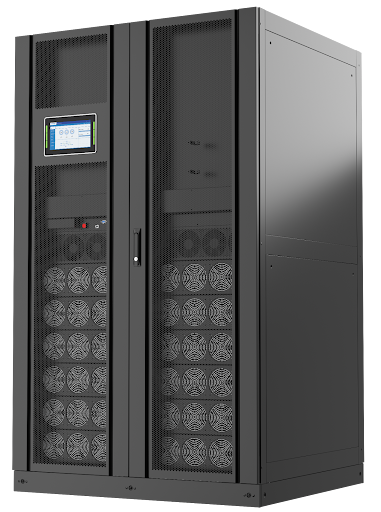
For example, you can use this flagship Modular UPS System from Prostarm (PM660) when you need only 50 kVA as well as 800 kVA within a single cabinet. This can be further paralleled across multiple cabinets to deliver up to 2.4 MVA of power. This brings a sigh of relief for building owners who can deploy just what they need today and scale up in the future without full system replacement.
2. Enhanced Redundancy and Reliability
Downtime brings huge disruption and losses for businesses. Modular UPS systems come with N+1 or N+X redundancy. This means there is at least one extra module even without needing it for the current load. If one module fails, the other one can handle everything without interrupting the power supply. This also improves reliability.
3. Hot-Swappable Maintenance
In many conventional UPS setups, even routine maintenance can turn into a headache. Usually, while servicing, the whole system will be turned off. This is not a viable option in crucial-work ecosystems where every second matters.
Modular UPS systems work very differently. Even when the system is still running, their components can be swapped, power modules, control units, etc can be replaced or upgraded. There’s no need to interrupt operations or plan risky shutdown windows.
4. Space and Energy Efficiency
High-rise commercial properties find it difficult to accommodate mechanical and electrical (M&E) room space. Compared to traditional systems, the modular ones come with a design that offers higher power density, delivering more kVA per square meter than traditional systems. Modular systems also bring in energy and operational efficiency by running the modules required to handle the real load.
5. Future-Ready and Adaptable
Commercial buildings are spaces where tenant changes, technology updates, and digital transformations take place most frequently. Without having to perform major redesigns, they can be adapted easily for phased integrations, capacity additions, and alignment with new power standards.
Conclusion: Investing in Resilience and Flexibility
Modular UPS systems come with a lot of advantages for high-rise commercial buildings, and with all the listed benefits in this article, they become the smartest choice for future-proofing the power backups for business and technology upgradation. Investing in a modular solution like the PM660, complementing it with other UPS technologies, is an optimal choice.